
Online Render Farm Service
Render smarter, not harder.
RenderSonic is an online render farm service that sits quietly in your system tray and turns your local Blender, Maya, 3ds Max, KeyShot or Cinema 4D scene into a cloud render job - no manual packaging, no uploading assets by hand, no forgetting a texture.
Windows 10/11 · installs and updates itself via Windows App Installer
- 3D apps fully supported
- 5
- Cost tracked per frame, live
- $/frame
- Manual asset packaging required
- 0
3D Software
One render farm service, every engine you already use
RenderSonic is a render farm service built around the software you already use - pick your application, see the render engines it supports, and submit straight from your scene.










Features
Every step of cloud rendering, automated
RenderSonic removes the manual overhead between your workstation and the render farm - so submitting to our online cloud render service feels the same as hitting render locally.
One-click plugin install
RenderSonic auto-detects the 3D apps on your machine and installs the matching submission plugin in one click - no manual copying of files into plugin folders.
Native submission menus
Submit straight from Blender, Maya, 3ds Max, KeyShot or Cinema 4D. RenderSonic reads your active scene and render settings automatically.
Automatic asset sync
Local textures, references and linked files are detected and synced to the cloud node before the job starts - nothing gets left behind.
Frame-by-frame inspector
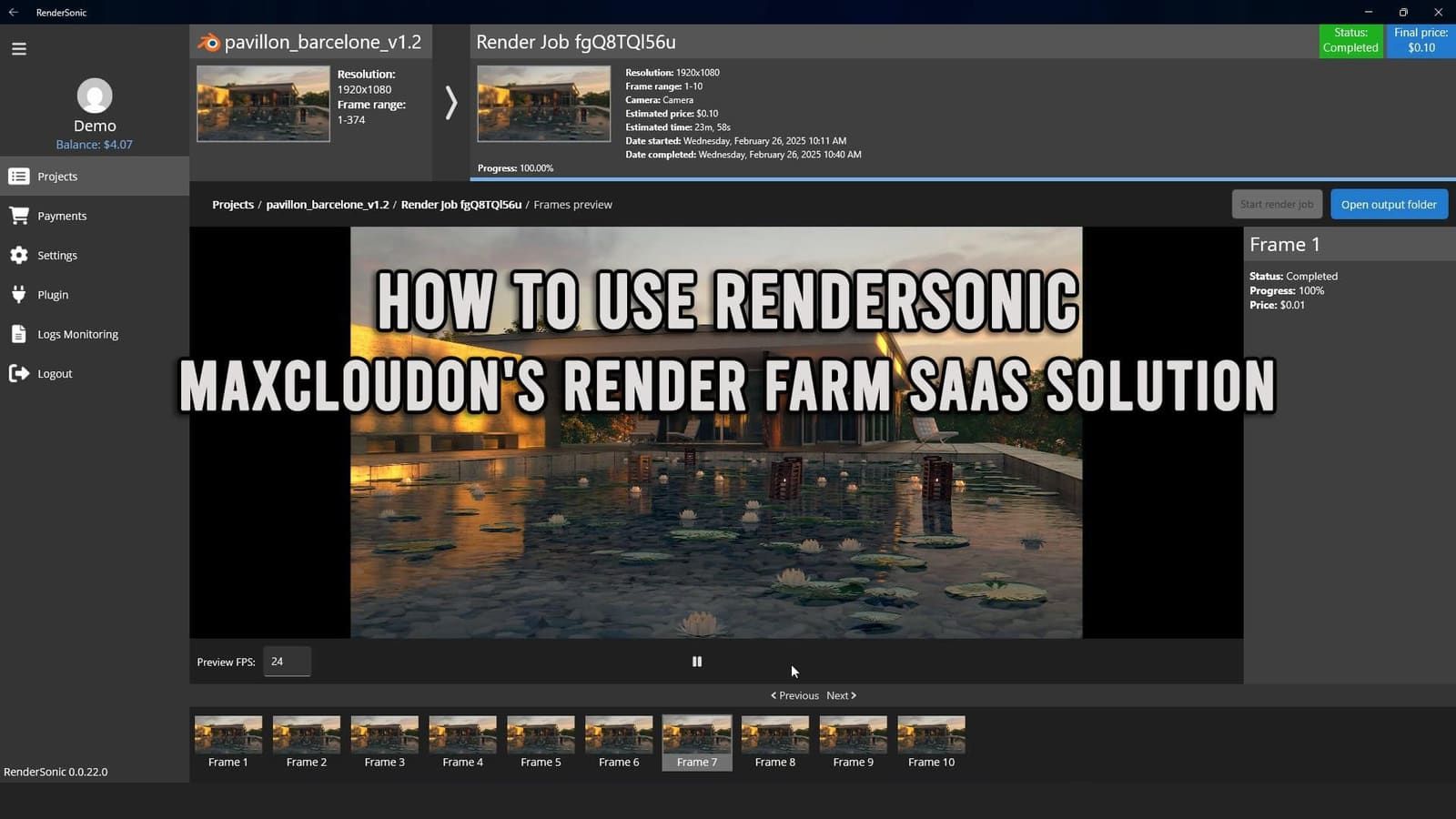
Every frame shows its own progress, status (queued, rendering, completed) and the cost it has accrued so far - with an upfront estimate before you commit.
Re-queue without reopening your scene
Queue new renders or tweak settings right in RenderSonic - switch between 720p, 1080p, 4K or custom presets, pick a camera or change the frame range, without reopening your 3D app.
Tray-first, file-explorer native
RenderSonic runs quietly in the system tray and delivers finished frames straight back into the local folder you already work from.
Workflow
From timeline to delivered frames, in five steps
- 01
Configure once
Point RenderSonic at your local project path and let it auto-install plugins for the 3D apps you use.
- 02
Submit from your scene
Hit render from inside Blender, Maya, 3ds Max, KeyShot or Cinema 4D - same workflow, just a cloud target.
- 03
Review the estimate
See upfront cost and time before you commit. No surprises on the invoice.
- 04
Monitor live
Track every frame as it queues, renders and completes, with progress and spend visible in real time.
- 05
Get files automatically
Finished frames land back in your local output folder the moment they're done - nothing to download by hand.
Demo
See RenderSonic in action
A step-by-step walkthrough of submitting a render, tracking progress and getting your frames back - watch it before you install.
Comparison
RenderSonic vs. Dedicated Cloud Servers
Both run on the same cloud infrastructure. RenderSonic optimizes for speed of setup and simplicity; Dedicated Servers optimize for full control over a custom pipeline.
| Feature | RenderSonic | Dedicated Servers |
|---|---|---|
| Setup time | Minutes - install & submit | Manual server configuration |
| Billing model | Pay per second, no reservation | Hourly / reserved server time |
| Admin access | Not required | Full remote desktop control |
| Custom pipelines | Standard 3D app integrations | Install anything you need |
| Best for | Regular renders in supported apps | Custom or non-standard pipelines |
Trust & security
Your scene files stay yours
Studios hand us proprietary assets every day. Here's what happens to them - and what doesn't.
- Render nodes online
- 1,200+
- Jobs completed to date
- 48k+
- Median support response
- < 15 min
- Platform uptime
- 99.9%
Encrypted in transit
Every upload and download between your workstation and the render node travels over SFTP (SSH) with AES-GCM or ChaCha20 encryption.
Auto-deleted after your job
Render job files and outputs are purged after 10 days, and project assets 20 days after your last job for that project - nothing lingers.
NDA available on request
Working on an unreleased project? We'll sign your NDA before your first job runs.
Try it on your own scene
$15
Free render credit for new accounts.

What studios are saying
Priya Kapoor
Lead Artist, Northshore Studio
"Went from dreading Friday deadlines to actually enjoying them. The whole team sees job status without pinging me."
Marcus Ohene
Freelance ArchViz Artist
"A client once asked how I render 4K interiors on a laptop. I just smiled."
Elin Sørensen
Production Manager, Kettle & Co.
"If you've ever had to explain a surprise cloud bill to finance, you'll understand why I love the upfront estimate."
Pricing
Billed by the second. Nothing to reserve.
RenderSonic bills per second for server time. Estimate the cost before you submit, watch it tick up frame by frame, and only pay for what actually renders.
- Pay only for the server time you actually use
- No extra charge for data transfer
- Encrypted SFTP transfer
- Render files auto-deleted after 10 days
- Prepaid credits that never expire
- Unlimited seats on one account
Output presets
FAQ
Render farm questions, answered
Can't find what you're looking for? Reach out and we'll get back to you.
What is a render farm service?
A render farm service is a cloud-based network of render nodes that takes 3D rendering off your local workstation. RenderSonic is an online render farm service built for artists - submit a job from Blender, 3ds Max, Maya, KeyShot or Cinema 4D and get your frames back automatically, without renting or managing servers yourself.
How does a render farm work?
A render farm splits a job across many computers (render nodes) so frames render in parallel instead of one after another. With RenderSonic you submit from inside your 3D app, the scene and its assets are synced to the cloud nodes, and finished frames are delivered back to your local output folder.
Is a render farm faster than rendering on my own computer?
For animations and batches, usually much faster: a 300-frame animation that takes 10 minutes per frame locally needs 50 hours on one machine, while a farm renders many of those frames at the same time. The exact speed-up depends on the scene and the hardware you choose.
How much does a render farm cost?
RenderSonic bills per second of server time, shown as a rate per GHz-hour, with no subscription or reservation. You see an upfront cost and time estimate before you submit, and live spend per frame while the job runs - see the Pricing section for the current rate.
How do I pay, and do credits expire?
RenderSonic uses prepaid credits, bought through Stripe with any payment method Stripe supports. Credits never expire, and you're only billed per second for the server time your jobs actually use.
What happens if frames fail to render?
If frames fail because of a problem on our side, we offer a full or partial refund or an equivalent credit. Claims must be made within 14 days of the job completing. Failures caused by errors in your scene, or by bugs in third-party 3D software, aren't refunded.
What is a GHz-hour?
A GHz-hour (GHzh) is the standard unit render farms use to price CPU time: one gigahertz of processor capacity running for one hour. A node with 32 cores at 3 GHz delivers 96 GHz, so one hour on it is 96 GHzh. Multiplying GHz-hours by the rate gives the cost.
Should I render on CPU or GPU?
You choose CPU or GPU nodes for every job. GPU nodes (NVIDIA RTX 5090, 4090, 3090 and A4000) are fastest for GPU-accelerated engines when the scene fits in video memory. CPU nodes (AMD EPYC, AMD Ryzen and Intel Xeon) suit very large scenes and CPU-only engines such as Corona.
How much RAM do the render nodes have?
Render nodes have 128 GB of system RAM, and AMD EPYC servers with 256 GB are available for very large scenes. GPU nodes run NVIDIA RTX 5090 (32 GB VRAM), RTX 4090 and RTX 3090 (24 GB) and RTX A4000 (16 GB).
How many render nodes will my job use?
There's no fixed number. RenderSonic scales capacity automatically with the overall queue and load, so a job may be picked up by 2 nodes or by 200, with its frames spread across them.
How quickly does my render start?
Usually within minutes. Cost estimates and preview frames are prioritized so you can check a job before committing to it, and more nodes are added automatically when the queue grows.
Which apps and render engines are supported?
Blender (3.x, 4.x and 5.x), 3ds Max, Maya, KeyShot and Cinema 4D are all fully supported. Supported render engines include Cycles, Eevee, V-Ray, Arnold, Corona, Redshift, ART, Scanline, Maya Software and KeyShot's native renderer.
Are third-party plugins supported?
Yes - all plugins are supported, including Forest Pack, RailClone, tyFlow, Geo-Scatter, FLIP Fluids, X-Particles, Yeti and Golaem. Each software page lists the available ones; if yours isn't listed, tell us and we'll add it. Bake simulation caches before submitting.
What are the system requirements?
RenderSonic runs on Windows 10 or 11 with an active internet connection. No dedicated GPU is required locally - the heavy lifting happens on the cloud render nodes.
How do I get my rendered frames back?
Automatically. Finished frames are delivered straight into your local output folder the moment they complete - there is nothing to download by hand.
Can I change resolution, camera or frame range without reopening my scene?
Yes. You can queue new renders from the RenderSonic app - switch between 720p, 1080p, 4K or custom resolutions, pick a camera or change the frame range - without reopening your 3D application.
Can multiple people submit from the same account?
Yes. A single RenderSonic account supports multiple user seats, so a whole team can submit jobs and monitor progress independently.
Are there extra charges for data transfer?
No. Uploading your scene and assets, and downloading finished frames back to your workstation, is included - you're only billed for the server time your job actually uses.
How long are my files kept?
Project assets are kept for 20 days after the last render job for that project, so you can queue new renders without uploading again. Render job files and outputs are kept for 10 days. After that, everything is deleted automatically.
Is it safe to render client work on RenderSonic?
Yes. Every upload and download travels over SFTP (SSH), encrypted with AES-128/256-GCM, ChaCha20-Poly1305 or AES-CTR. Files are deleted automatically - render job files and outputs after 10 days, project assets 20 days after your last job - and we'll sign your NDA before your first job on an unreleased project.
What if I need a custom software pipeline?
RenderSonic is built around standard 3D app integrations. If you need full control over installed software or a non-standard pipeline, Dedicated Cloud Servers give you complete admin access instead.
From the blog
Notes on rendering, faster
Get started
Submit your first render in five minutes
Install RenderSonic, connect your favorite 3D app, and submit your first job to our render farm service in under five minutes.